PHNOM PENH: The Ministry of Environment is tightening its approach to suppressing natural resource offences under an expanded “Green 2.0” strategy, with environment minister Eang Sophalleth saying cases must be thoroughly documented, sent to court and followed through, with no exceptions.
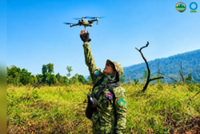
The ministry is looking to satellite imagery and drones to strengthen evidence in cases involving forest clearing and land encroachment, while expanding legal cooperation to support officials and others involved in protecting natural resources.
Sophalleth outlined the approach on Monday (Aug 10) during the opening of a two-day WWF-Cambodia workshop in Phnom Penh, where he noted that environmental enforcement needed to go beyond detecting an offence or intervening at the scene.
“When an offence occurs, the documentation must be clear and professional. It must be sent to court,” he said.
He stressed that authorities also needed to follow cases through the judicial process rather than considering their work complete once an alleged offence had been stopped.
Sophalleth acknowledged that weak following up could allow people involved in illegal forest clearing or land encroachment to return to the same areas and resume their activities.
He cited the example of authorities intervening to stop forest clearing, only for those involved to return later, cultivate the land and eventually claim they had occupied or used it for several years.
“We have to follow it through to the end,” he said.
Environment minister Eang Sophalleth outlined the approach on August 10, during a two-day WWF-Cambodia workshop. Hong Raksmey
The minister described the expanded approach as “Green 2.0”, saying it would build on existing environmental protection efforts by strengthening law enforcement, incorporating technology and widening cooperation among those involved in protecting natural resources.
Technology is expected to play an increasingly important role in the approach, particularly in determining when forest clearing or land occupation occurred.
Sophalleth said modern satellite imagery could provide detailed evidence of changes in forest cover and land use over time, allowing authorities to compare current conditions with historical images.
This could be particularly useful when individuals claim they have occupied or cultivated disputed land for a long period.
“If they say they have lived there for five years, we can look back five years,” he said.
Historical satellite images, he explained, could help establish whether such claims were supported by evidence and provide authorities with a clearer factual basis when investigating suspected encroachment.
Drones could also be deployed to inspect suspected forest and land offences more quickly, particularly in locations that are difficult for officials to reach or monitor continuously.
The minister said drones could be sent to suspected encroachment sites to provide images showing what was taking place on the ground, complementing satellite data and other evidence gathered by authorities.
The greater use of technology, he suggested, could make environmental enforcement more precise while strengthening the evidence available when cases proceed through legal channels.
The approach forms part of the ministry’s broader environmental agenda under its Environmental Chakra Strategy 2023-2028, which focuses on the three pillars of “Clean, Green and Sustainable”.
The strategy includes strengthening climate resilience, promoting green economic growth, increasing forest cover and achieving carbon neutrality by 2050.
Sophalleth also explained that environmental protection under the Green 2.0 mechanism should involve a wider range of actors rather than remaining the responsibility of government institutions and law enforcement agencies alone.
He called for cooperation with environmental advocates, civil society organisations, NGOs and other domestic and international organisations.
“The environment has no borders and no fences,” he said, noting that environmental challenges such as climate change and air pollution extend beyond administrative and national boundaries.
The minister also highlighted the role of lawyers in ensuring that environmental protection measures and enforcement actions comply with the law.
He said legal assistance should not be limited to ministry leaders, officials or park rangers, but could also extend to people involved in protecting the environment and natural resources.
His remarks suggest that legal expertise could be made available more broadly to those engaged in environmental protection, although Sophalleth did not provide details about who would qualify for such assistance, how it could be requested or whether a formal mechanism would be established.
He said broader cooperation was necessary because environmental challenges could not be addressed by the ministry, or the government, acting alone.
The Aug 10-11 multi-stakeholder workshop on “Landscape Finance and Nature-Positive Agriculture for Sustainable Development in Cambodia”, was organised by WWF-Cambodia at the Himawari Hotel.
More than 80 representatives from Cambodian government partners, financial institutions, agribusinesses, development partners, civil society organisations, research institutions and communities attended the event. - The Phnom Penh Post/ANN