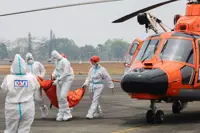
JAKARTA: Indonesia is seeing a sharp increase in respiratory illnesses as a prolonged dry season fuels widespread land and forest fires, with health facilities in parts of Kalimantan and Sumatra reporting thousands of additional cases in recent weeks amid worsening air quality.
The Health Ministry told The Jakarta Post on Monday that it had recorded around 15.6 million cases of acute respiratory infections nationwide since January, about 200,000 more than during the same period last year.
The ministry, however, cautioned that the largest outbreaks have been concentrated in densely populated provinces on Java, suggesting that the increase cannot be attributed solely to wildfire smoke.
Still, health authorities in several fire-affected provinces have reported marked increases in respiratory complaints as haze blankets communities.
West Kalimantan, one of the provinces with the largest burned areas this year, has seen emergency room visits for respiratory infections soar since July. The local administration has ordered all regional public hospitals (RSUD) and community health centres (Puskesmas) across its 14 regencies and cities to provide 24-hour emergency medical services in response to the surge.
“Poor air quality has caused a spike in cases of respiratory illness,” said Hary Agung Tjahyadi, director of RSUD Dr. Soedarso in Pontianak, the provincial capital.
Health facilities across West Kalimantan have recorded around 5,000 emergency room visits for respiratory infections each week since July, compared with about 500 a week during the first half of the year.
The worsening conditions have coincided with a sharp expansion of wildfires across the country. Forest monitoring platform Nusantara Atlas estimates that about 285,000 hectares have been burned this year, an area roughly three times the size of Jakarta.
Most fires have been detected in parts of Kalimantan and Sumatra, exposing residents to increasingly hazardous levels of smoke and fine particles.
On Monday, Pontianak became the country’s most polluted city, with air quality reaching “hazardous” levels, the worst category on the six-level air quality index monitored by Swiss-based air-quality monitoring company IQAir.
South Sumatra has also recorded a significant increase in respiratory infections. The province has reported nearly 260,000 cases this year, already surpassing the total recorded throughout 2025.
The Health Ministry has subsequently urged residents in smoke-affected areas to monitor air quality, reduce outdoor activities and limit their exposure to haze. People experiencing symptoms associated with respiratory infections have also been advised to seek medical attention.
The Meteorology, Climatology and Geophysics Agency (BMKG) has warned that the combined influence of El Nino and the warming climate pattern known as the positive Indian Ocean Dipole could extend the country’s dry season until early next year.
Experts have compared the conditions to those in 2019, when more than 1.64 million ha of land and forest were burned across Indonesia.
The health effects of wildfire smoke can be particularly severe because it contains a mixture of toxic particles and compounds released when vegetation and other organic matter burn.
Short-term exposure can cause upper respiratory, skin and eye problems, while prolonged exposure can have more serious consequences, according to Budi Haryanto, a public health expert at the University of Indonesia.
“If they cannot escape from long-term exposure to the haze, the health impacts will be more severe and it can damage vital organs,” Budi said.
Katherine Hasan, a lead Indonesian analyst at the Centre for Research on Energy and Clean Air (CREA), said wildfire haze also posed a particular challenge because it was generated by uncontrolled biomass burning.
Unlike pollution from vehicles and power plants, where filtration systems can partially trap pollutants, smoke from large-scale forest and land fires is released directly into the atmosphere and can travel long distances.
“The smoke from forest and land fires is completely uncontrolled, allowing it to directly spread outdoors, and is dense enough to be detected by space satellites and capable of traveling long distances,” she said.
The cross-border effects were evident last week, when haze from fires in Kalimantan drifted into neighbouring Sarawak in Malaysia, prompting authorities there to temporarily close more than 100 schools. - Jakarta Post/ANN