Textile artist Noorazah Hanim Mohd Noor, or better known as Xeem Noor, can knit for hours on end, her hands moving steadily as if guided by instinct – keeping fidgety fingers busy and restless thoughts gently in line.
She picked up the habit at a young age, and over time, what began as a quiet pastime evolved into something deeper. In her adult practice, knitting has become a way of reaching out – a tactile language that connects where words sometimes fall short.
Patient, gentle and thoughtful, that sensibility threads through her installation Balai Di Balai (Tatemonologue 2.0), now showing at the National Art Gallery (NAG) in Kuala Lumpur.
The installation is part of the gallery’s Hanya Satu (Singles) artist spotlight series and marks Xeem’s first solo exhibition in Malaysia. It follows the work’s initial presentation during her Koganecho Artist-In-Residence Yokohama residency in Japan last year.
Upon entering the NAG foyer, visitors can step into the installation, on view until April 8. The work comprises printed fabric panels featuring images from her Koganecho experience, alongside 68 letters she wrote to the Yamamoto apartment building and its 10 pillars.
Happy and safe
The residency programme is distinctive for its downtown Yokohama setting, allowing artists to live, create and exhibit within an urban community. It also features studios scattered across the area, including spaces converted from former illegal establishments.
“It (Koganecho) used to be a district, controlled by the Yakuza, with a dark history. It has been less than 20 years since it was reclaimed, so I expected to feel troubled by these traces. But when I entered the building, I felt oddly happy and safe. I started writing letters to the building, calling it ‘Tatemono-san’ (Mr Building) and I treated it like my friend,” says Xeem, 41, in a recent interview in KL.
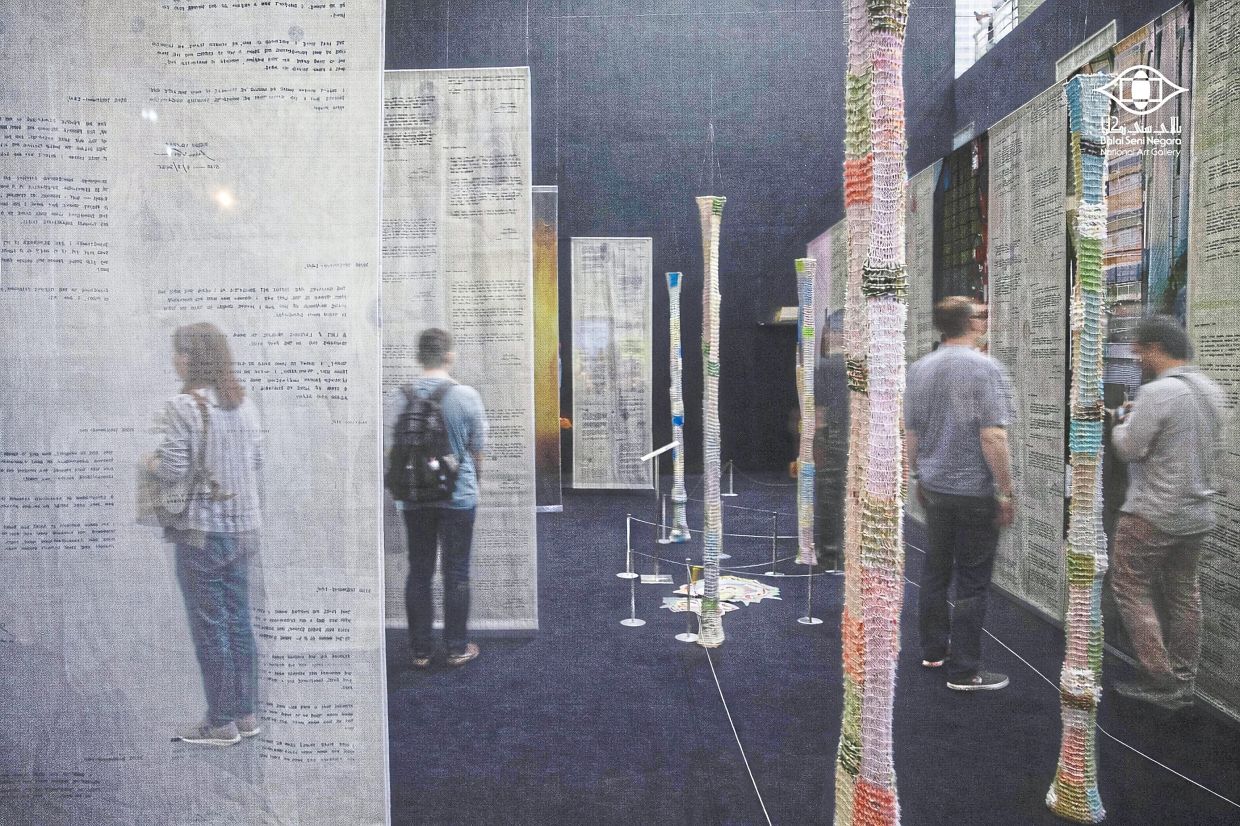
Anthropomorphism is a common practice in Japanese culture, and Xeem’s daily letters to the building did more than document her experiences in a foreign land – they brought a warm, personal, and alternative narrative to the neighbourhood.
“The pillars of the building had these grooves, which were joints that would connect with other structures, and so I would place these letters into them, as a way of communicating with it and to show my gratitude for welcoming me into its space. I was the first Malaysian to stay in that area,” says Xeem, who was born and raised in Selangor.
The installation presented in Yokohama was inherently interactive, designed to be a living repository of shared touch.
“I wanted the Japanese visitors to send their emotional energy to the installation through touch, so that when I brought it back to Malaysia, the same installation would be touched by visitors here.
“It was a way of cultural exchange for which I served as the conduit. They described my hashira (post) work as kira kira (shiny), mofu mofu (fluffy), and fua fua (cloudy),” she explains.
Xeem spent the three-month residency living and working alongside artists from different parts of the world, collecting precious memories with them in long conversations and blending the “magic of Koganecho” into each other’s works.
Shaping emotion
Xeem’s background – a degree in architecture and a Master’s in Fine Arts (sculpture) from Universiti Teknologi Mara (UiTM) – combined with her focus on interactivity, shows that her work goes beyond visual observation.
She invites visitors to engage emotionally by touching her work. Her three-dimensional pieces, crafted from a mix of materials, sit at the intersection of sculpture and textile.
“I have around 30 years of experience in knitting and crochet, so constructing feels second nature to me. It’s very much a design process in terms of how I approach an artwork. I begin with intuitive drawings and sketches – I call them studies – to figure out how I want the installation to flow, where I want to use certain materials,” she says.
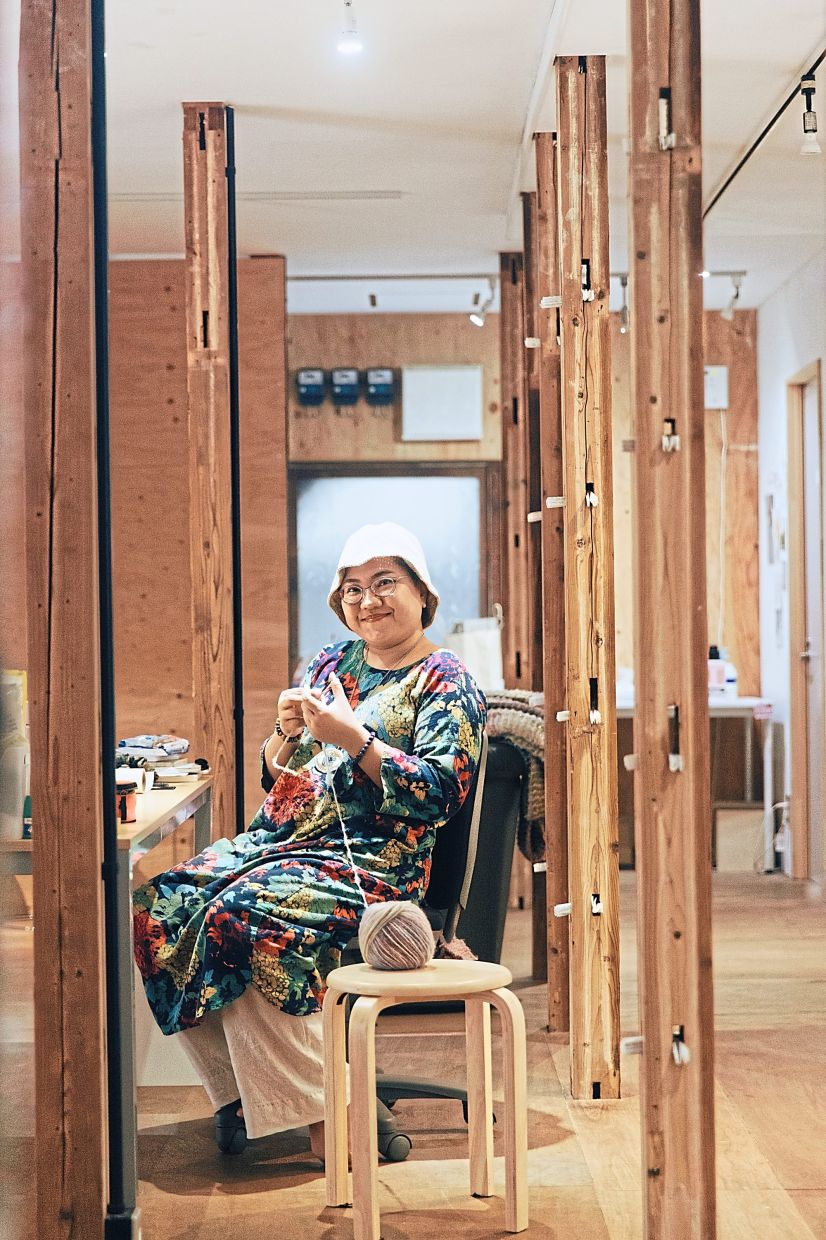
In the Balai Di Balai installation, the complexity of the design is not immediate. Closer inspection reveals different yarns intertwining, making shapes narrow and wide. The result is an almost identical recreation of the structure, almost as if it were knitted to wrap around the pillar first before being unsheathed.
“Unlike crafters who are particular in how they want their work to look in the end, I think to let the material breathe its own life. If it wants to stay afloat it can do so, if it wants to stay heavy and hang, it can do so as well. Me and the yarn are collaborators in this work,” says Xeem, who also exhibited in Frankfurt, Germany, as part of a residency programme organised by the Goethe-Institut Malaysia in 2023.
By combining the immediacy of abstract painting with the deliberate pace of hand embroidery, she creates a space that allows her the time and freedom to process ideas, moments and experiences.
“Textile is tactile, you wear it daily, physically touching you without you knowing. And touch is your first sensory language, so even if we can’t speak to each other, we both know the meaning of softness. This is a way of communicating beyond words, opening up to be vulnerable.”
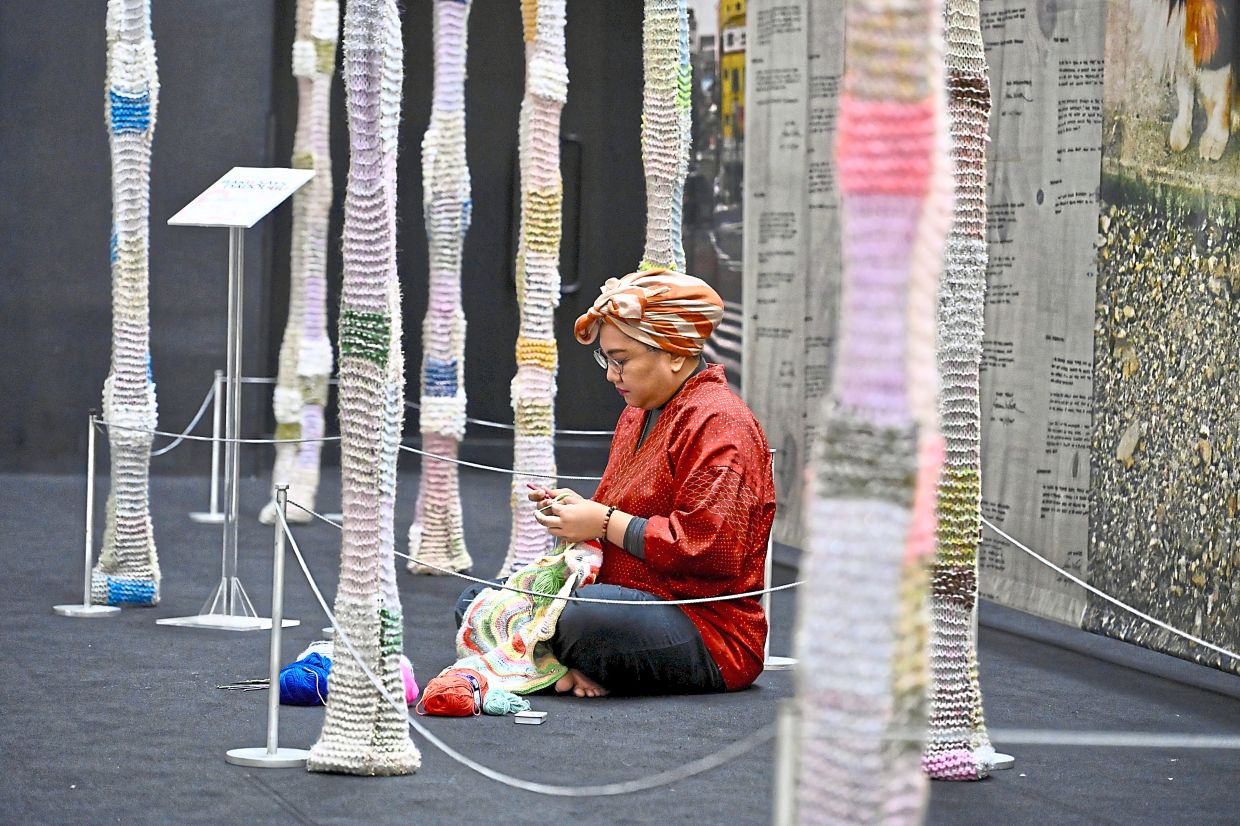
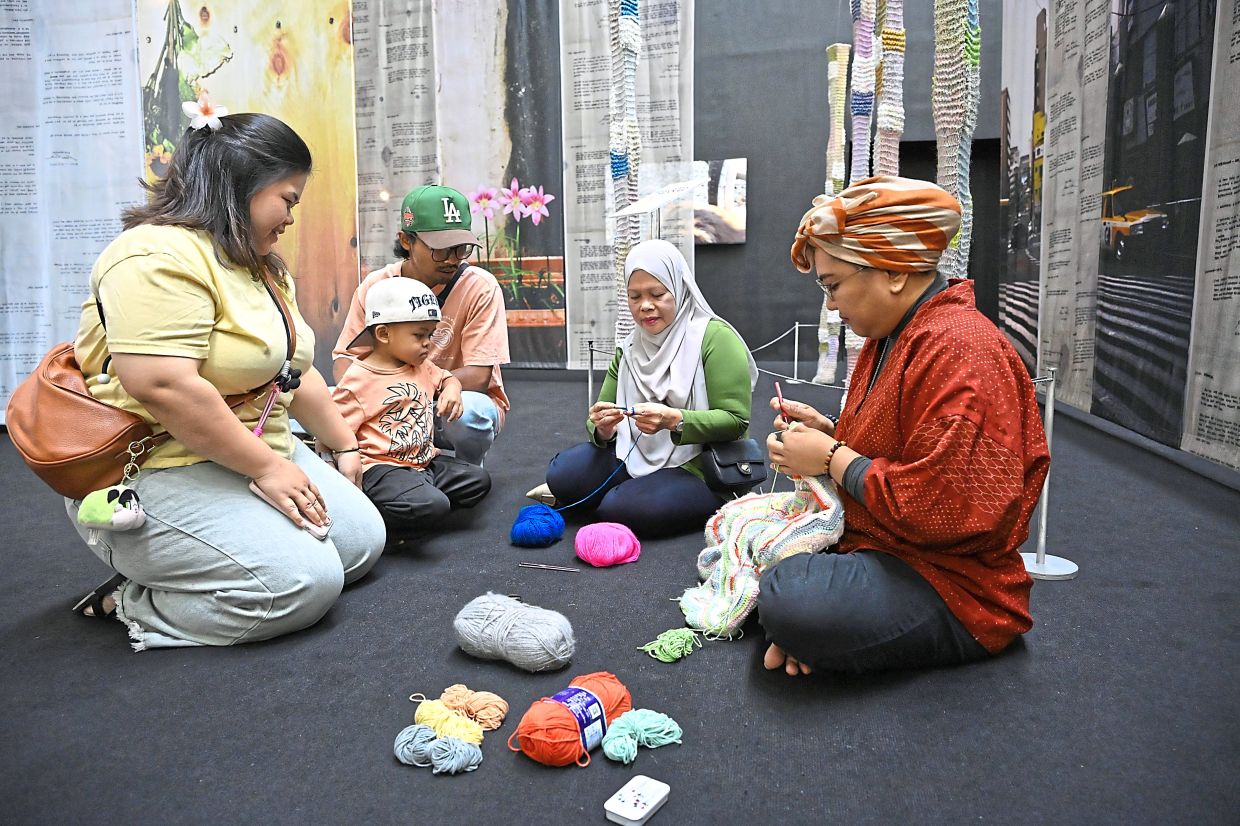
This philosophy carries through to the live sessions Xeem is hosting at NAG during the Balai Di Balai exhibition, which go beyond simple demonstrations to become intimate, collaborative acts of creation.
Xeem will lead live crochet sessions every Wednesday, Saturday and Sunday from 11am to 3pm until April, demonstrating her craft and gradually building a large collaborative piece, layer by layer.
“I’ve set myself to be vulnerable in these sessions, so you have to respect that. I believe this is an apt practice to have here, because it’s a free gallery, so visitors might take things for granted. I’m inviting you to my space, so to reciprocate, you must observe your budi pekerti or manners as one should,” she says.
It’s a gentle but firm reminder that the space she creates is sacred, built on mutual effort and respect.
“Materials are provided by me, but I’m not there to teach. So if you are determined to contribute and be a part of this work, you must meet me halfway and learn to crochet for yourself. It won’t take you that long to learn on your own. You have until April,” she concludes.
Xeem Noor’s Balai Di Balai (Tatemonologue 2.0) exhibition is showing at the National Art Gallery in Kuala Lumpur until April 8.