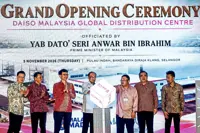
KLANG:Malaysia aims to turn its ports into bigger economic value generators instead of focusing solely on cargo throughput, says Datuk Seri Anwar Ibrahim.
The Prime Minister said the country must build on its strategic position along the Strait of Malacca to become a world-class logistics hub.
“Our next step is to build on that strength and capture more of the value that flows through our ports, instead of only the volume,” he said at the opening of Daiso’s new Global Distribution Centre in Pulau Indah here yesterday.
Anwar said Port Klang handled a record 15.1 million twenty-foot equivalent units (TEUs) last year, placing it among the world’s 10 busiest container ports.
He said the distribution centre reflects Malaysia’s ambition to attract more value-added activities, with goods arriving from around the world processed locally before being shipped to international markets.
“Goods will be sorted, stored and repacked for different global markets right here in Pulau Indah.
“This is where the value and skilled jobs will be created,” he said, adding that the government is also investing in port, rail and air transport infrastructure to strengthen the country’s logistical capabilities.
“At sea, Westports 2 will nearly double Westports’ capacity, and we are planning a future mega-port at Pulau Carey.
“On land, the East Coast Rail Link (ECRL) and our rail freight network will carry more cargo to our ports and off our highways.
“In the air, we are expanding airport and air cargo capacity.
“Through a refreshed National Transport Policy, these will work as one system,” he said.
“Next year, a household in a global city like Dubai or Manila or Sao Paulo may well pick up a Daiso storage container, glassware or stationery that was processed and packed right here in Pulau Indah and passed through our facilities on its way to them.”
Anwar, who is also Finance Minister, said the government is seeking to raise the country’s economic ceiling while improving Malaysians’ livelihoods under the Madani Economy framework.
He said the success of investments should not be measured solely by their headline value but also by the quality of jobs created, the development of local capabilities and the opportunities given to Malaysian suppliers.
“So, we do not measure ourselves only by the headline dollar figure of the investment we attract.
“We also ask whether it creates better-paying jobs, builds local capabilities, links with Malaysian suppliers and supports sustainable development,” he said.
Through the New Industrial Master Plan 2030 and its investment incentives, Anwar said the government is increasingly rewarding investments that delivered these wider benefits.
“Investors who bring higher-value activities, skilled jobs and local partnerships should find Malaysia the most rewarding place to grow.”